
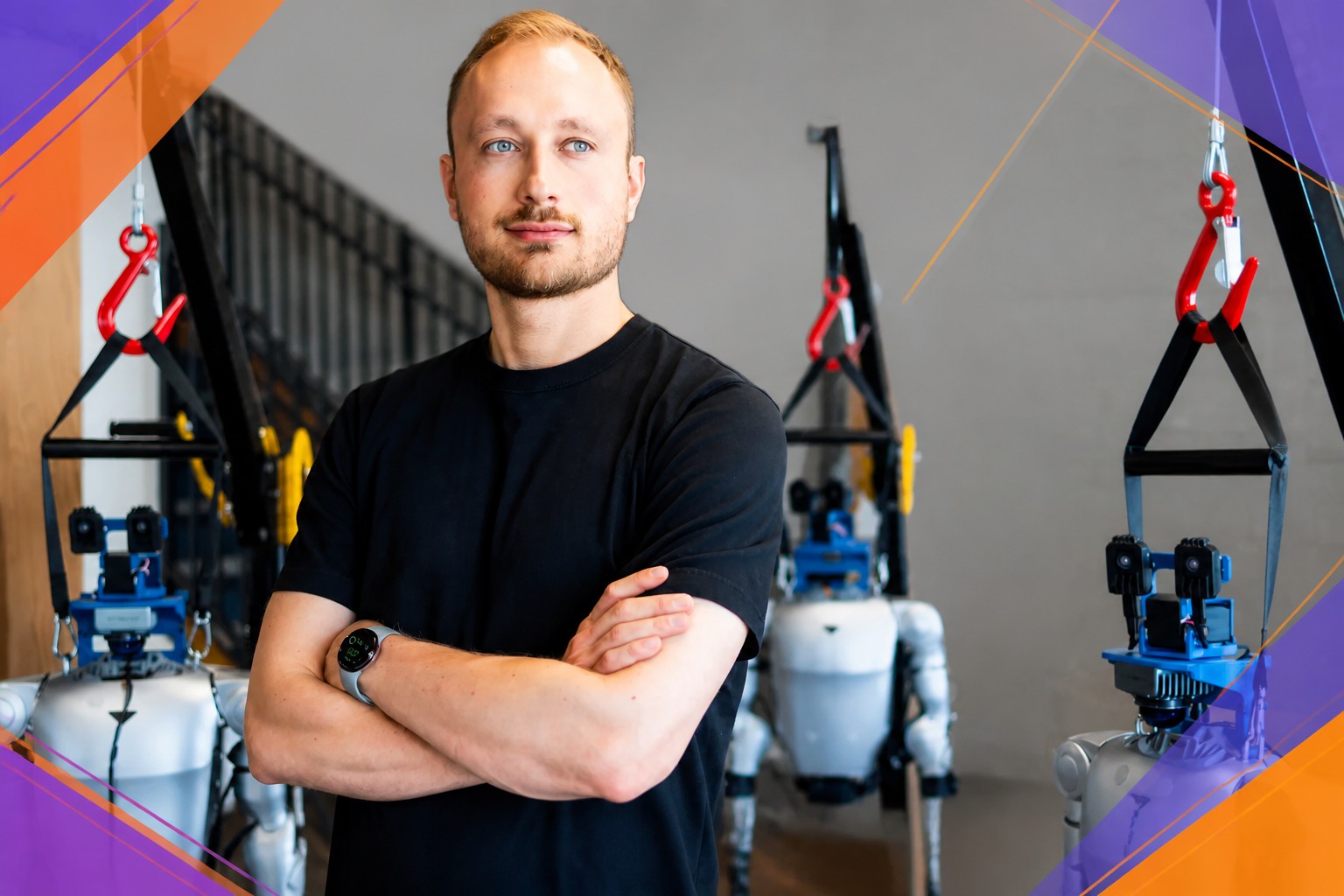
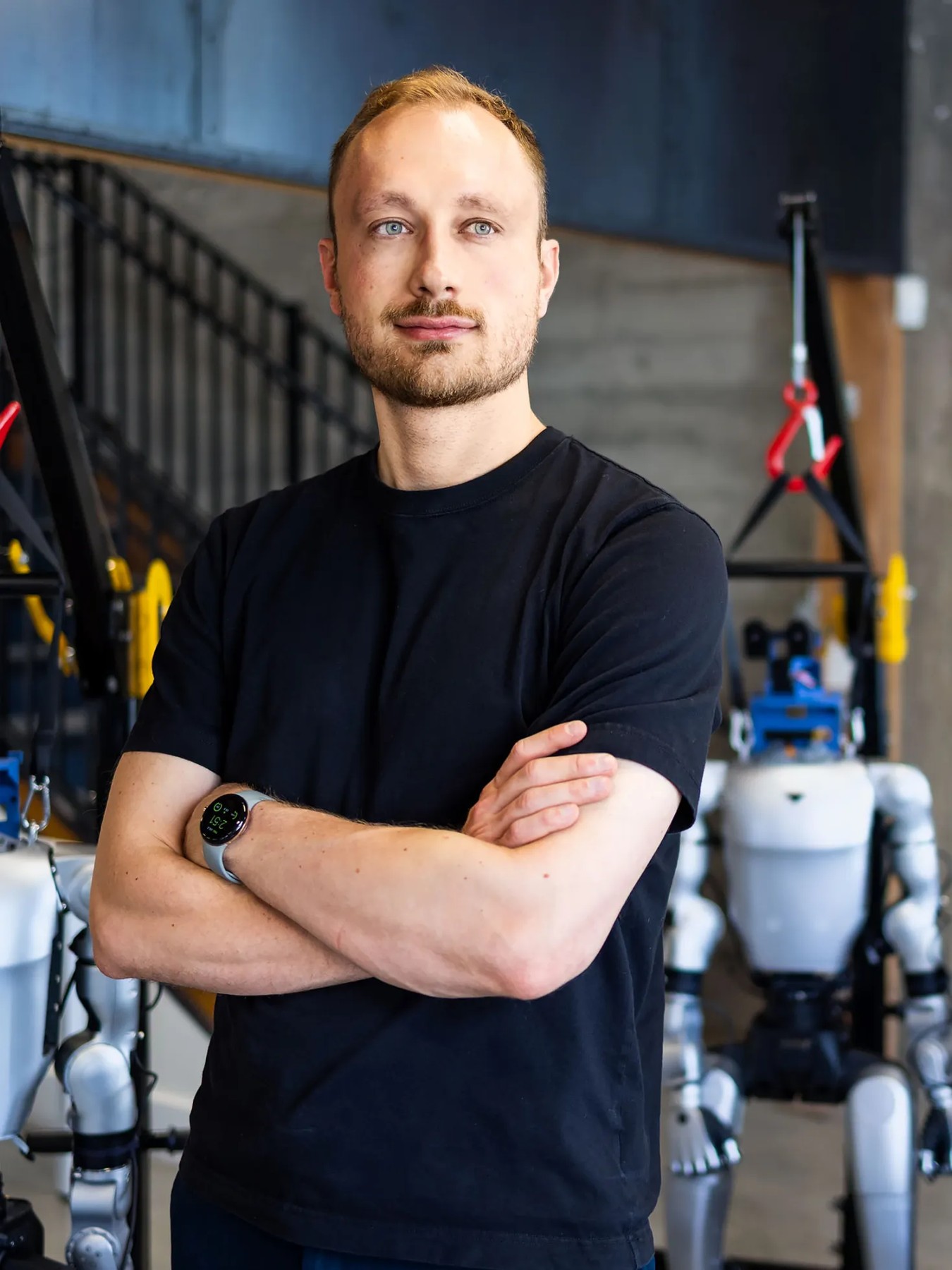
Hafner, 31, has left Google DeepMind and started a robotics company whose name is not yet on the door. The office in San Francisco's SoMa district is close to empty: one employee on the day of a visit, almost no furniture. The exception runs down the middle of the room, where humanoid robots of different shapes and sizes hang from racks like marionettes. The robots are shipped in from China. What Hafner is building is the part that goes inside them — agents trained inside simulated worlds so that a machine can cope with a room it has never seen.
Source: technologyreview.com
The method is model-based reinforcement learning. Hafner builds world models — AI models that imitate physical reality — and trains agents inside them. The agent treats the model as a stand-in for the real world and learns to act in it, then uses that accumulated experience to predict the consequences of its own future actions. Hafner's word for this is "dream": the agent imagines how things might go before committing to anything. The payoff is that agents, and the robots they run in, can handle unfamiliar situations without the conventional trial-and-error training in the real world.
That constraint is the whole argument for the approach. A robot that works in human space has to respond to situations nobody checked in advance. A domestic robot has to deal with a floor plan and furniture it has never encountered.
Hafner has spent years testing the idea against video games, and the sequence reads as a deliberate escalation. PlaNet let agents plan their actions ahead of time. Dreamer 2 was the first agent to reach human level on Atari 2600 games using a world model. Dreamer 3 was the first agent to solve Minecraft's diamond task on its own, mining the in-game diamonds without human help. Dreamer 4 learned to mine diamonds from an offline dataset of recorded gameplay, without ever interacting with the game directly.
Then he moved the agents out of the virtual world. In the DayDreamer project, the Dreamer algorithm let robots operate on their own in new conditions and react to experiences nobody had scripted — being shoved and falling over, for example — without a separate training regime for each case.
The credentials are unusually deep for a founder this early. Hafner grew up in a small rural town in northeastern Germany, both parents classical musicians; a neighbor taught him to program, and in high school he started taking online AI courses, drawn to how thinking works and to the idea of reproducing it on a computer. In 2015, in his second year of an engineering degree at the Hasso Plattner Institute in Potsdam, he landed a student researcher position at Google Brain. Roughly a dozen internships and several staff roles followed, across Google Brain and Google DeepMind — later merged under the DeepMind name — in the UK, Canada and the US. His colleagues included Geoffrey Hinton, often described as one of the founders of modern AI, and Ashish Vaswani, a co-author of "Attention Is All You Need", the paper that described the transformer architecture underneath today's large language models. Timothy Lillicrap, his former manager and a co-author on his Google work, rates him among the most visible researchers in a field of strong ones, and says Hafner frequently built alone what would have taken whole engineering teams a long time. Another colleague puts him in the top half of the top 1% of Google's researchers.
Here is what I find most telling about the setup in SoMa. Hafner is not building robots. He is buying them, from China, in assorted shapes, and treating the body as a commodity input — which is a bet that the scarce thing in embodied AI is the policy, not the actuator. That bet is coherent with his entire research record, and it is also the most crowded assumption in the sector right now. The item on his list that deserves more attention than the Minecraft headlines is Dreamer 4: an agent that learned a long-horizon task from recorded gameplay alone, never touching the environment. Translated out of games, that is learning robot behavior from video — the one path that does not require a fleet of machines breaking themselves in warehouses to generate data. If the SoMa startup has a commercial thesis, that is the likeliest shape of it.
Notably absent from everything Hafner has said so far: the company's name, its funding, its team, its product, and any date. He is evasive about next steps and hints at wanting to solve a problem that could change the world, which is the least informative sentence available to a founder. Absent too is a demonstration outside a game or a lab. Dreamer's public record is Atari, Minecraft and research robots that recover from a push. The domestic robot handling a floor plan it has never seen remains the motivating example, not the result.
He left DeepMind in the autumn of 2025, which means the quiet period has been running for about a year — long enough that the next thing out of that room will be judged as a product, not a paper. World models have a decade of benchmark wins behind them and almost no deployments. Hafner has chosen to be the person who has to close that distance in public.