Adapting the agent's interface beats retraining the model

In the race for smarter LLM agents we reach almost reflexively for the familiar levers: a bigger model, more fine-tuning, a round of RL, a rewritten system prompt. The authors of Adapting the Interface, Not the Model ask an uncomfortably simple question: what if the agent fails not because it reasons badly, but because it is badly wired into its environment?
When the problem is the wiring, not the model
An agent is more than the LLM itself. A whole layer sits between the model and the world: how observations are presented to it, how tools are described, how actions get executed, how errors come back, how loops get cut short. That layer is what the authors call the runtime harness, and it is what they propose adapting instead of the model's weights.
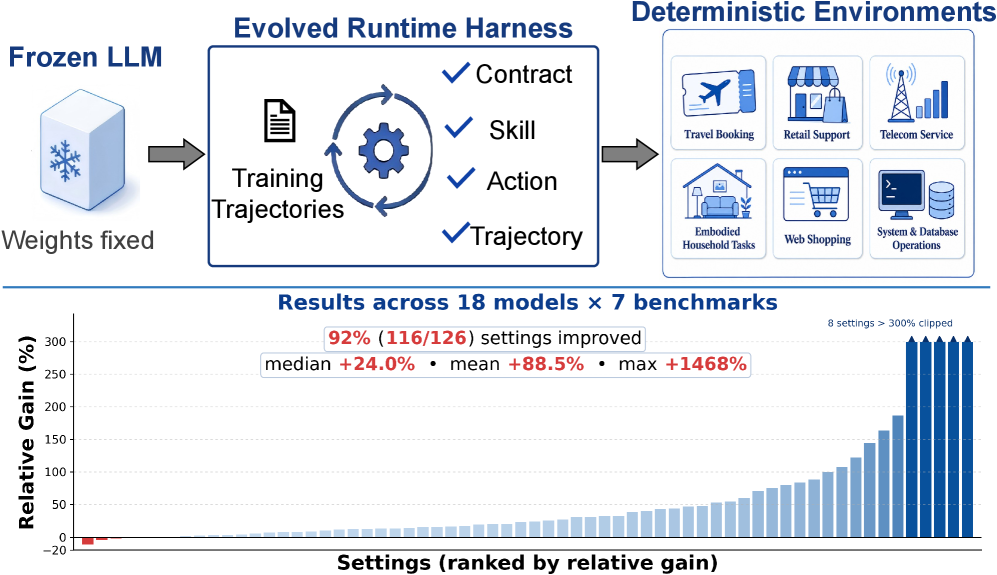
The result is striking: their Life-Harness system improves performance in 116 of 126 model-environment pairings across seven deterministic tasks, with an average relative gain of 88.5%. All of it without changing the weights of the model.
Why this matters
The industry thinks model-first by default. If an agent handles an operating system badly, botches a database query or gets lost in an online store, the standard prescription is to fine-tune it on similar trajectories. There is logic in that, and there is also a bill: training is expensive, tied to one specific model, and often transfers poorly to other environments.
The authors show that in deterministic, tightly regulated scenarios — the ones with fixed rules, fixed tools, fixed response formats and clear success criteria — many failures happen at the boundary between model and environment. Not because the model cannot reason, but because:
That is interesting against a familiar paradox of current LLMs: a model can solve hard math and still stumble through an agentic scenario that looks trivial, because the job there is not to understand the task but to act according to the environment's contract.
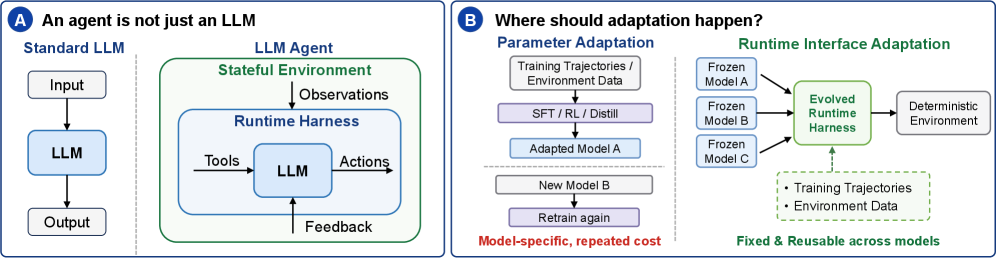
That is why the work matters as more than another way to push metrics up. It offers a more practical view of agentic systems: before retraining the model, check whether the thing is actually breaking in the operational layer.
What Life-Harness is
Life-Harness is a multi-layer runtime harness that improves the behavior of a frozen agent. The model's weights do not change, the test environment does not change, and the harness itself evolves over training trajectories and is then fixed for evaluation on new tasks.
The key idea is that recurring failures do not have to be baked into the model's parameters; they can be turned into reusable interface interventions.
The system is built as four layers along the interaction lifecycle:
In practice that means Life-Harness can, for example, remind the model that a flight search accepts only an origin city, a destination and a date; stop a plainly invalid call before it goes out; point out that an online-store task requires picking size and color before hitting buy; or recognize a pointless loop of identical commands.
How the authors arrived at this architecture
The paper's strength is not only the result but the fact that the architecture did not come out of thin air. The authors first went through the base agent's failed trajectories by hand and classified the typical causes of failure.
They ended up with four categories:
This is the important part. Popular discussion of agentic systems likes to collapse every problem into bad reasoning by the model. The picture here is different: in deterministic environments the failures are highly varied, and a large share of them require no improvement to the model at all.
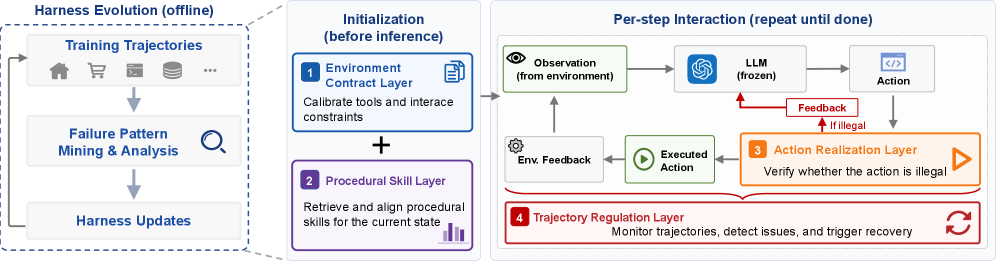
Hence the design of Life-Harness: different kinds of errors get caught in different places. Some call for rewriting the contract, some for mixing in a procedural skill, some for filtering an action before it executes, and some for halting a degradation already under way.
Technically, the system evolves over training trajectories with the help of a coding agent: it reads the logs, finds recurring error patterns and proposes updates to the relevant layers. The test tasks stay hidden, and once evolution is finished the harness is frozen. So this is not online tuning against the test set; it is a distinct development stage for the interface layer.
Where they tested it and what came out
The authors ran Life-Harness on seven environments drawn from three task suites: airline, retail and telecom scenarios, household interactive tasks, an online store, operating-system control and databases. That is a good spread: it covers both business workflows and the classic agentic benchmarks.
The notable part is that the harness was evolved only on trajectories from Qwen3-4B-Instruct and then applied to 17 other models. So what the authors tested was not whether a system can tune a prompt to one model, but whether the structure it discovers about an environment transfers across model families.
The headline numbers:
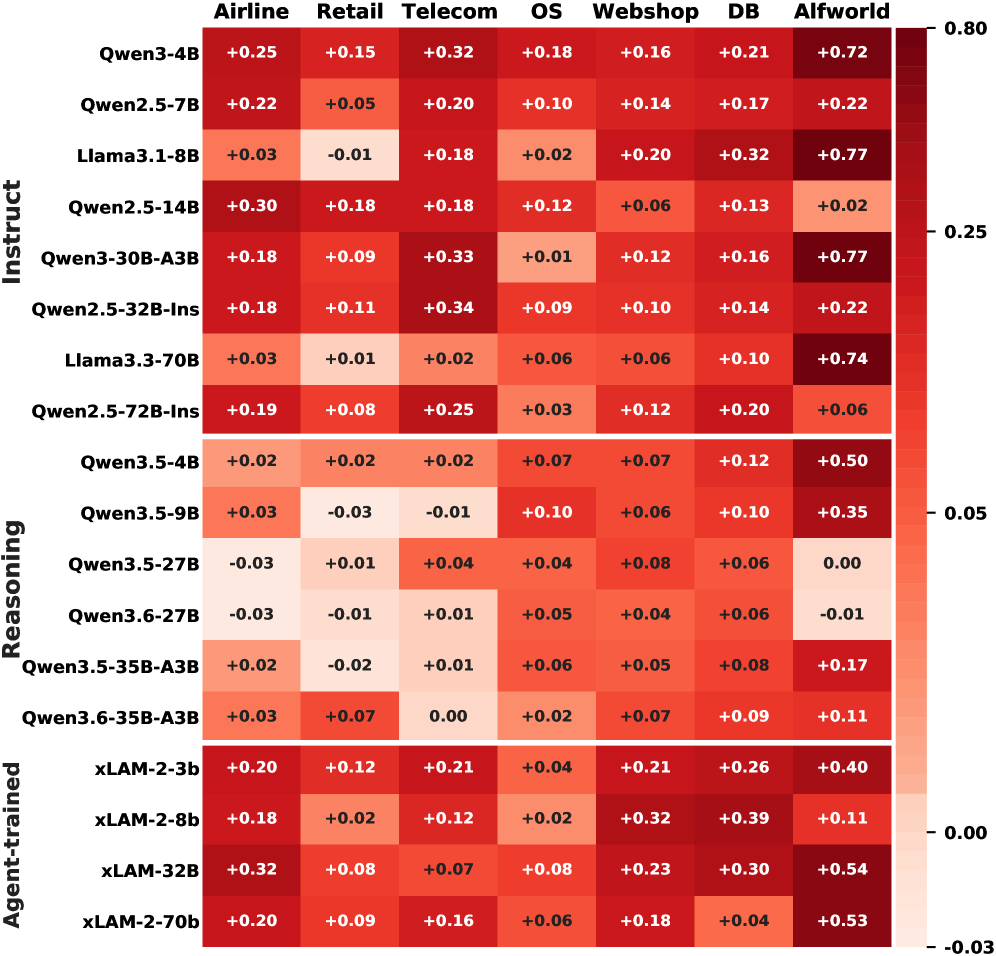
Averaged across models, it looks like this:
These are not cosmetic gains. In several cases they are the difference between an agent that is broadly unreliable and one you can actually work with.
Another important finding: small models with a good harness start competing with much larger ones. For practitioners that may matter more than another SOTA record. If quality can be raised without fine-tuning and without moving to a model that costs several times more, the economics of agentic systems change on the spot.
Why this beats evolving the prompt alone
The authors compared Life-Harness directly against an approach that evolves only the system prompt. The prompt helps too, but far less. That makes sense: a prompt acts only at the entrance, and most of an agent's problems arise during the interaction.
A prompt cannot:
That is why the runtime harness turns out to be the stronger option: it works not only as text handed to the model, but as an active interface between the agent and the environment.
How this compares with training the model
One of the most interesting sections of the paper compares against models that have already gone through specialized tool-use training. At first glance, a model fine-tuned for agentic scenarios should not need an extra harness. The results show something more complicated.
The authors compared the base Qwen2.5-32B-Instruct, its specialized derivative xLAM-2-32B, and both versions with Life-Harness on top. The conclusions:
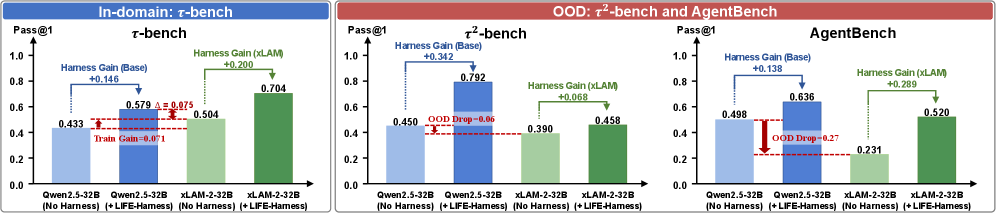
This is arguably the paper's main practical claim. Training and interface adaptation solve different problems. Training fits the model's internal behavior to a data distribution. The harness fits the interaction to a specific environment. They are not direct competitors — they complement each other.
What stands out in the work
First, the paper takes a sober engineering view of agents. Instead of a magical call for more reasoning, it offers a concrete analysis of where exactly the interaction loop breaks.
Second, the authors produced a good decomposition of failures. This is not abstract philosophy about the system level but a working scheme that lets you localize a problem and fix it without retraining everything else.
Third, transfer across 18 models is a very strong argument. It shows that Life-Harness really is learning not the habits of one particular LLM but the structure of the environment itself.
Finally, the work lands squarely in production reality. In a shipped system you rarely want to retrain a model for thousands of GPU-hours; you want a reliable improvement to the execution, validation and error-handling layer.
Limits and what comes next
The authors are honest about the boundaries of the approach. Life-Harness works in deterministic, formalized environments with stable rules, well-defined tools and reproducible failures. Those are ideal conditions for interface adaptation.
In open-ended tasks, where goals, tools and success criteria all shift, the approach will be much harder to apply. The less stable the environment, the harder it is to write a fixed contract, and the smaller the chance that the interventions you find will be reusable.
Even so, the boring, tightly regulated scenarios — databases, internal APIs, operating systems, business processes — are where most of the practical value of agentic systems sits today. The limitation does not devalue the result so much as mark out where it pays off most.
The takeaway
The paper hits a very precise target: not every agent failure has to be cured with a new model. Sometimes it is enough to fix the interface through which the model sees the world and acts in it.
Life-Harness shows that the runtime harness is not a secondary engineering detail but a target for optimization in its own right — and a cheap, transferable, practically useful one. In a field where everyone is racing to train ever larger models, that sounds close to heresy, which is exactly what makes it interesting.
The paper's central claim comes down to this: the future of agentic systems probably depends not only on how smart the model is but on how well its contact with the environment is built. And on this evidence, that is where one of the most underrated sources of improvement currently sits.
AI paper breakdowns
Every day we read the new AI papers and retell what matters in plain language — no hype, no filler. If you want to see where AI agents are heading before everyone else, subscribe.
New breakdowns every day
On Telegram