Agentic RL trains long-horizon behavior, not single answers

How reinforcement learning (RL) is used not just to produce a "good answer", but to produce behavior that holds up in dynamic conditions.
Until recently, reinforcement learning for LLMs looked like this: the model is shown a prompt, it produces one answer, and that answer gets scored — by people or by automatic metrics. This works well for tuning style, politeness and instruction-following, but it looks almost nothing like real work, where you have to act step by step, make mistakes, correct them, go find information and remember what happened a minute ago.
The authors of the survey “The Landscape of Agentic Reinforcement Learning for LLMs: A Survey” suggest looking at an LLM differently: as an agent that lives in an environment and makes decisions over a long horizon. That is the shift toward agentic reinforcement learning (agentic RL) — where RL is used not just for a "good answer" but for behavior that holds up in dynamic conditions: with tools, memory, planning and partial observability.

The problem: single-step logic versus long tasks
Classic RL post-training can usually be described as a degenerate case: one step, one answer, and it is over. The survey formalizes it this way: instead of a single-step process, the authors recast the dialogue in the language of POMDPs — problems where the agent sees not the whole world but only a slice of observations, and has to act in sequence to accumulate information and reach the goal.
In agentic settings, an action is not only text. It is also a tool call (search, code, a browser, an API), movement through an environment (in a game or a GUI, for instance), a memory update, a choice of reasoning strategy. And the hardest part: the reward often arrives much later, for having actually solved the task.

Two maps of the territory
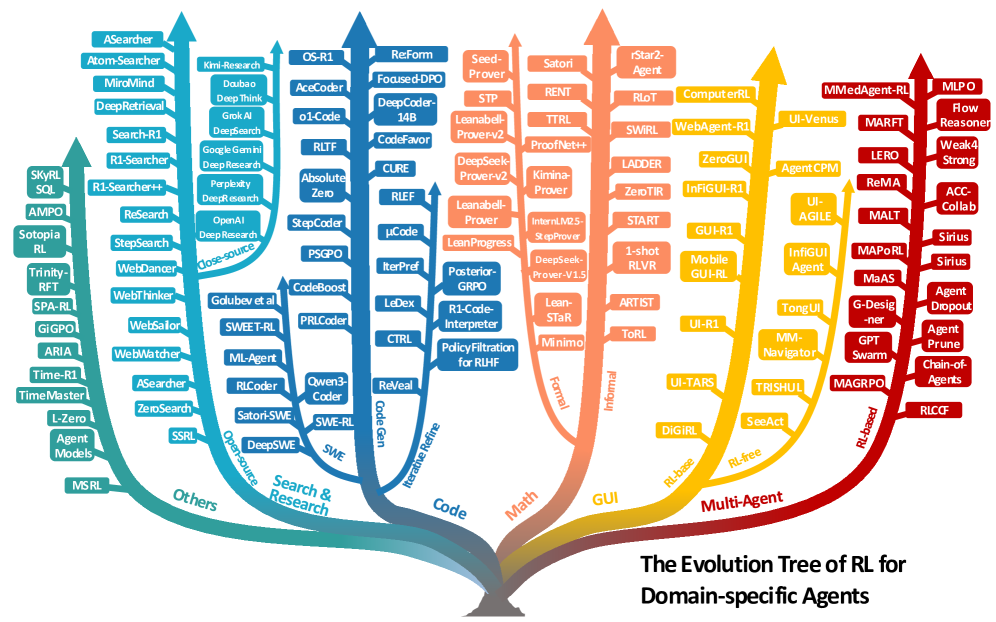
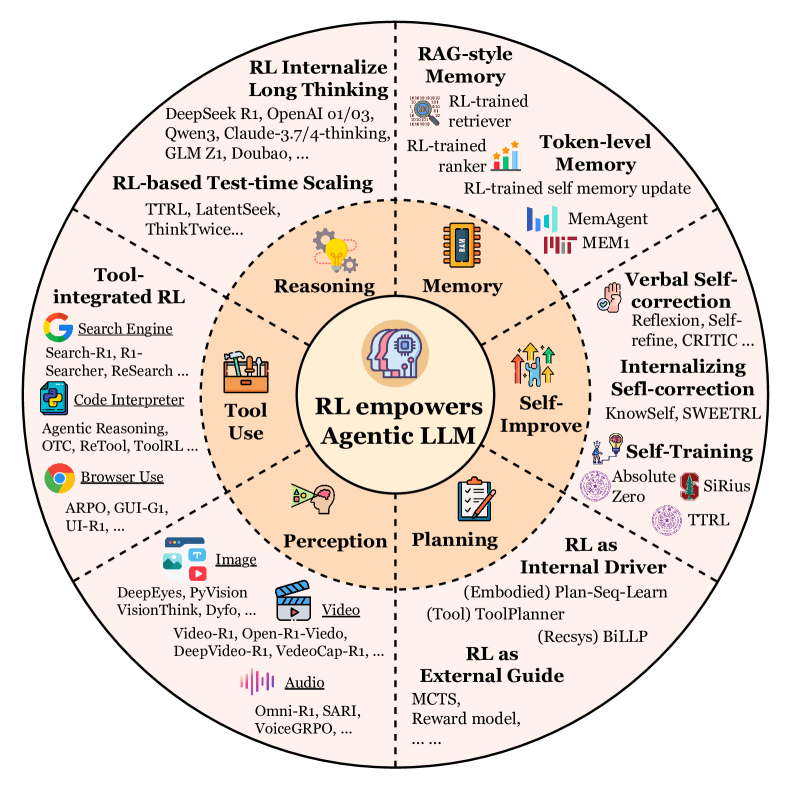
The paper is essentially a large guide through hundreds of scattered studies. The authors synthesize more than 500 works and propose two axes.
The first is agent capabilities. This covers planning, tool use, memory, reasoning, self-improvement and perception. What matters is that agentic RL treats these components not as scripts bolted on top, but as parts of behavior that can and should be shaped by reward. RL turns static heuristics into adaptive habits.
The second is task classes: research agents for search, coding and software engineering, math, GUI navigation, vision tasks, embodied scenarios and multi-agent systems. Cutting the field this way helps explain why some approaches work while others scale badly on the web.
What actually makes RL agentic
One of the survey's most useful points: RL starts to matter most where the model has to learn to choose — when to plan deeper, when to call a tool, what to write to memory, how to correct itself after a mistake. Prompt engineering and SFT can imitate the right patterns, but they rarely deliver robustness to surprises. RL ties behavior to the outcome: it worked, reinforce it; it failed, rebuild the strategy.
This is clearest in tool use. In early architectures the model simply repeated the Thought → Action → Observation template. Agentic RL moves the field toward tool-integrated reasoning, where the tool is not an appendage but part of reasoning and decision-making — on long tasks, and with the credit assignment problem attached: how do you avoid punishing useful exploration that did not pay off right away.

What comes out of it: real wins and honest limits
The survey shows that agentic RL is strongest wherever the result can be checked: code (unit tests), formal verification, executable pipelines, verifiable vision metrics such as IoU. That is exactly why coding and SWE scenarios are where progress is fastest: RL teaches the model not only to write code but to fix it iteratively, to call the interpreter at the right moment, to hold together long trajectories of edits.
But the authors do not hide the fundamental difficulties either. The main one is that same temporal credit assignment in real environments: the reward is sparse, the path is long, and a failure may be noise from the environment rather than stupidity on the agent's part. Add to that the cost of tools (web search, browsing), the instability of sources, and the risk of learning workarounds instead of the actual task. Which is why the future directions read as a clear demand for sturdier evaluation protocols, careful intermediate signals and scalable environments.
The main takeaway
This survey shows that agentic RL is, at bottom, about raising behavior in agents. Once an LLM becomes an agent, what matters most is the ability to plan toward a goal and get to a result, to check itself, to use tools, to remember context and to adapt. And it is RL, in the authors' view, that turns all of those pieces into a system that can be trained.
AI paper breakdowns
Every day we read the new AI papers and retell what matters in plain language — no hype, no filler. If you want to see where AI agents are heading before everyone else, subscribe.
New breakdowns every day
On Telegram