LAMP turns economic news into a signal RL agents can act on

Economics textbooks are tidy: prices, taxes, rates, utility. In real life, the decisions of people and governments are constantly nudged by words — news, conversations, expectations, rumors, public statements. The same set of numbers reads differently depending on whether the talk around it is "a crisis is coming" or "everything is under control". That layer of reality stayed awkward for reinforcement learning for a long time, and especially for multi-agent systems: classical reinforcement learning wants clean signals, and language is full of hints, ambiguity and strategic behavior.
The authors of Think, Speak, Decide: Language-Augmented Multi-Agent Policy Learning in Economic Environments propose LAMP, a framework that carefully builds language into policy learning inside economic simulators. The idea is not to replace reinforcement learning with LLM answers, but to teach the system to use text as one more source of information and coordination — the way people do.

Standard MARL (multi-agent reinforcement learning) learns well enough from numerical observations: wages, tax schedules, inequality measures. But as soon as textual news and messages from other market participants enter the environment, the trouble starts: the model struggles to tell what in the text matters, how to map it onto the economics, and whether the source can be trusted.
The other approach — let the LLM solve the task directly — does not rescue things either. An LLM writes and reasons well, but without systematic policy optimization it tends to be unstable: it can explain a move without necessarily finding a strategy that works.
LAMP is meant as a compromise that takes the strong side of each: behavior optimization from RL, interpretation and communication from the LLM.
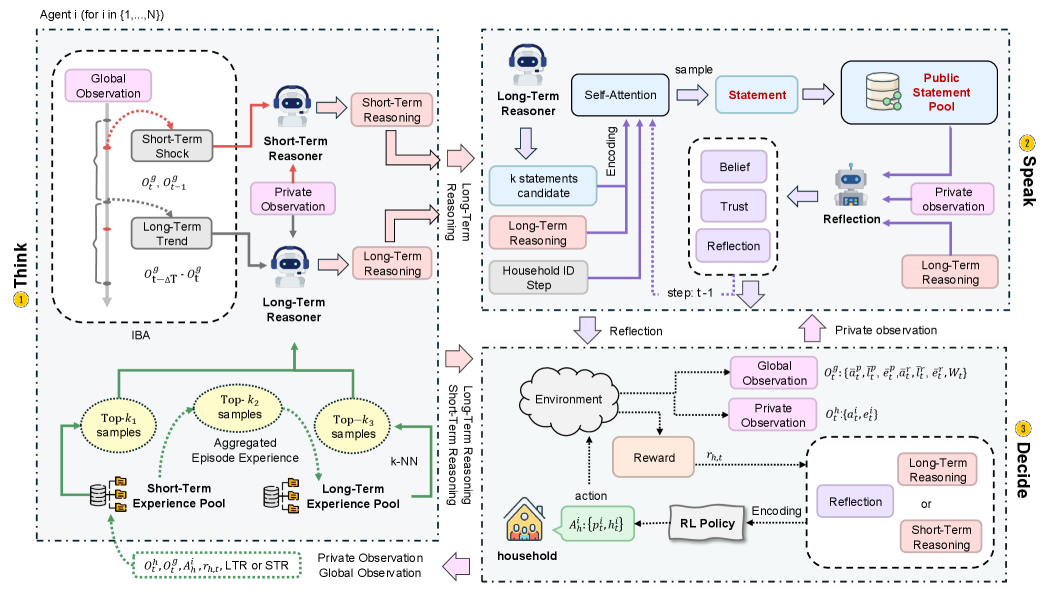
Think–Speak–Decide: how LAMP is built
The framework adds up to a recognizably human loop.
First, Think. The simulator holds global economic indicators, and the LLM works as a newsroom: it turns numerical changes into short texts about short-term shocks and long-term trends. Crucially, the system does not just produce a line of reasoning and forget it. It stores successful reasoning trajectories in an experience pool and can later pull up similar examples through retrieval (FAISS), by semantic similarity between situations. It is close to how an economist recalls past crises and holds them up against the current one.
Then Speak. The agent drafts a short public message about its position or intentions — several variants, not one — and a scorer picks which to send. The other agents read that message through an LLM and update their beliefs: who they are dealing with, how far the counterpart can be trusted, how wealthy it is, and what it will probably do next. The result is a model of social expectations — imperfect, but workable.
Finally, Decide. At this step the decisions are made by an RL policy (MADDPG under CTDE in the paper). The texts are not fed in as raw language: they are encoded into embeddings, normalized and appended to the numerical features. Language becomes a compact control signal that helps the agent act, not just explain itself well.
What came out of it
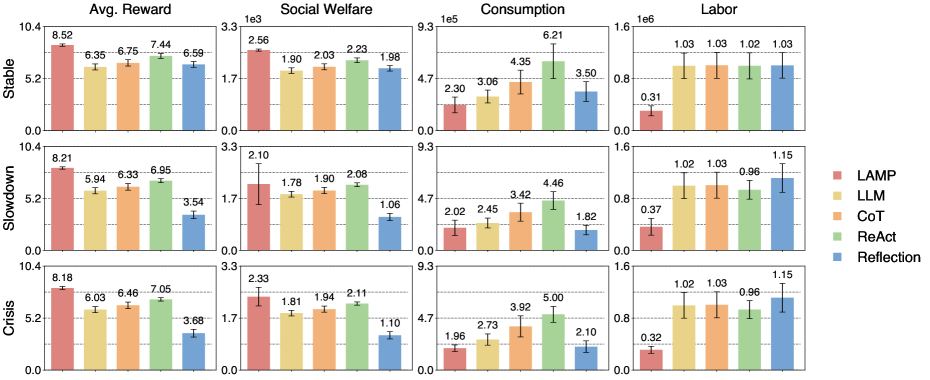
The experiments run in TaxAI, an economic simulator with heterogeneous households and a government, where growth, taxes, labor, consumption and social welfare have to be balanced against each other. The authors test three regimes: a stable economy, a slowdown, and a crisis shock.
In the stable scenario, LAMP clearly beats pure MARL and LLM-only approaches on total reward and stability, and also wins against stronger text baselines such as ReAct and Reflection. The interesting part is that the metrics improve not head-on but through fine optimization: welfare and reward go up while consumption and labor may actually fall — which, in terms of household utility, is sometimes the sensible outcome (working more is not always better).
The comparison charts show it plainly: LAMP delivers higher social welfare on average and steadier behavior across environments than alternatives that either do without language or lean on an LLM with no strict policy optimization.
Remove the long-term module — the long-term news and the use made of it — and quality drops sharply. Switch off the experience pool that retrieves past successful reasoning, and welfare sags while the economy's lifespan before collapse gets shorter.

What this gives us
The main takeaway is that language in economics is a full data stream for economic models and an instrument of strategic interaction. LAMP shows how to fold that stream into a learned policy without the system falling apart over long scenarios.
It is also a step toward more interpretable agents. When a system stores and reuses chains of reasoning, a researcher has an easier time seeing why one strategy was chosen over another — not only from the network weights, but from the textual trace the decisions leave behind.
AI paper breakdowns
Every day we read the new AI papers and retell what matters in plain language — no hype, no filler. If you want to see where AI agents are heading before everyone else, subscribe.
New breakdowns every day.
On Telegram