Many systems called world models stop at one-step prediction

Generative AI comes with a convenient illusion of competence: the model writes, draws, sometimes even "plans," and it looks as though there is something like a picture of the world inside it. But the moment a system is asked not to continue text but to act toward a goal over a long horizon — drive a robot, navigate websites, negotiate with people, run scientific experiments — an uncomfortable fact surfaces. The binding constraint is not the polish of the answers but the ability to model the dynamics of the environment: what happens after an action, where the system will go wrong, and how it should rewrite its own assumptions when the world fails to match the prediction.
When AI stops guessing the next token and starts understanding the world
That is exactly the subject of the long survey Agentic World Modeling: Foundations, Capabilities, Laws, and Beyond. It is not another catalog of models and benchmarks but an attempt to bring order to the chaos around the term world model, which means very different things in RL, computer vision, LLM agents and AI for science. The authors propose a simple approach: look at a world model along two axes — level of capability and the type of world laws the system has to work with.
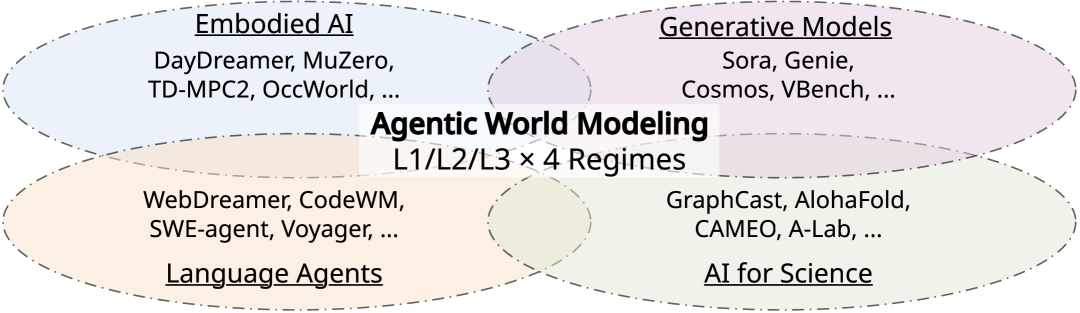
Why does this matter? Because today one team calls a video generator a world model if it predicts frames well, and another means a dynamics model for planning in RL. Formally both are right; in practice, comparing such systems is close to meaningless. The new survey offers a shared vocabulary that could connect communities that have been talking past each other, and finally answer the question: which model actually helps an agent make decisions, and which one merely imitates plausibility.
Not one world model, but three levels of maturity
The paper's central idea is to split the world model into three levels.
L1: Predictor — a local predictor. It forecasts the next step: the next latent state, frame, token, observation. This covers classic latent dynamics models, a share of video models, and in general anything that works well over a short horizon. Such models are useful, but they carry a fundamental weakness: single-step quality is no guarantee that the model will not drift into fantasy once it is rolled out repeatedly.
L2: Simulator — a simulator in the working sense of the word. It has to support multi-step, action-conditioned rollouts that are good enough to select actions from. Here the authors introduce three strict criteria for the jump from L1 to L2: long-horizon consistency, sensitivity to interventions, and satisfaction of domain constraints. Put differently, if a model paints a convincing future but does not react when the action changes, or breaks the laws of its world, it is not yet a real simulator.
L3: Evolver — the most ambitious level. A system like this does not merely simulate the environment; it revises its own world model when it runs into a systematic error. This is no longer planning inside a fixed model but a loop that resembles the scientific method: design an action or an experiment, run it, observe, diagnose the failure, update the model, and verify that the update actually improved behavior.
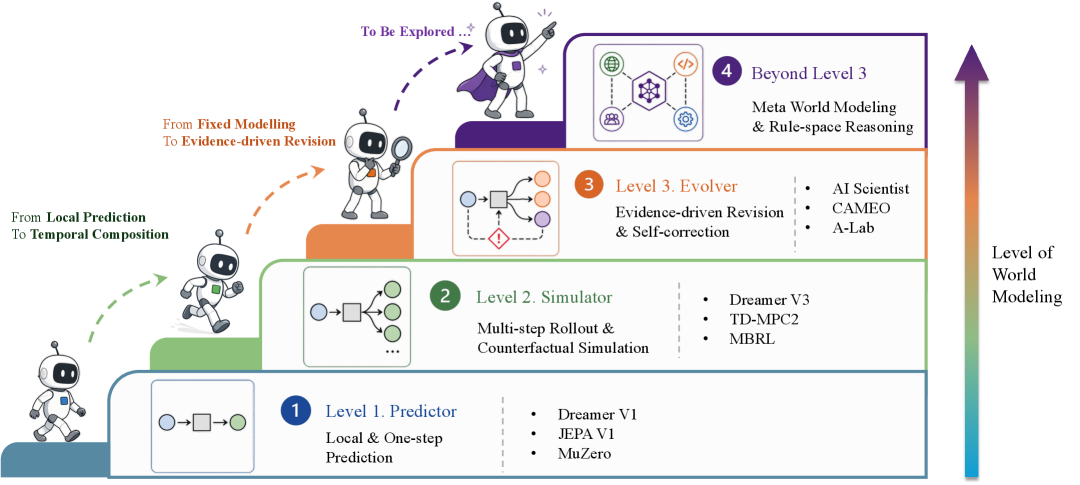
The ladder looks almost obvious, and that is precisely where the survey's value sits. The authors do not argue philosophy about whether a model "understands" the world; they give a practical criterion: what it is capable of in decision-making. One step? Several steps under an action? Or correcting itself as well?
Worlds differ: physical, digital, social, scientific
The second axis of the taxonomy is the type of "laws" a model has to obey. This is where the paper is especially useful: it reminds you that a world model for a robot, for a browser agent and for a lab AI are not just different applications of one technique. They have different sources of truth and different kinds of error.
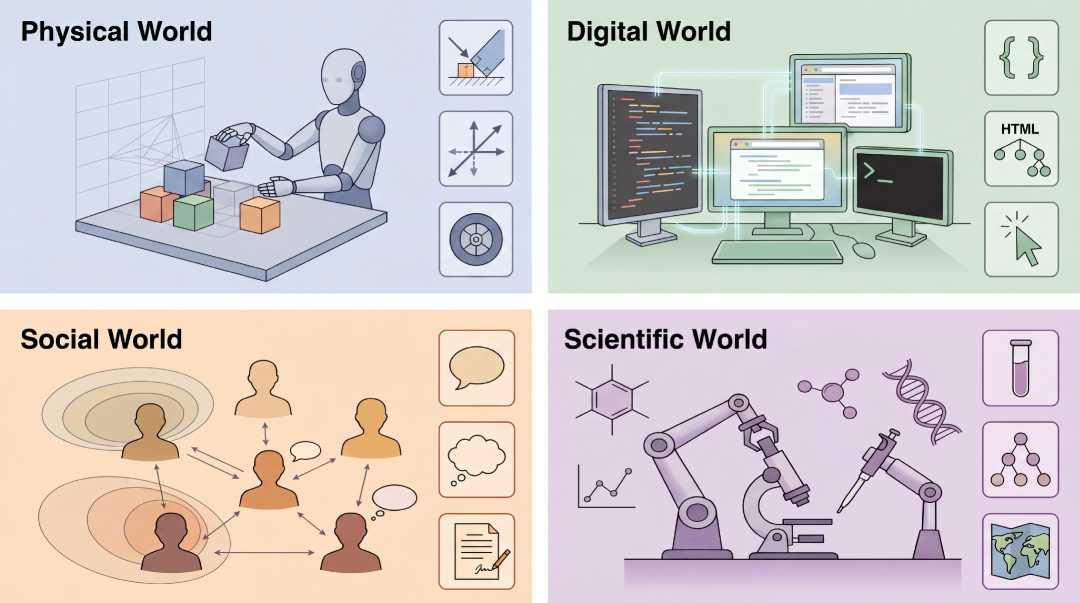
The physical world is mechanics, geometry, contact, stability. If a robot predicts that a cup will pass through a table, the problem is obvious.
The digital world is interfaces, APIs, file systems, code, UI state. Here the world is often more deterministic than physics, but it is full of branches, exceptions and rare cases. An error is checkable: a nonexistent API call or a broken DOM is not "almost right," it is simply wrong.
The social world is a different animal altogether. What matters here is beliefs, goals, norms, promises, roles, expectations. A system can carry a grammatically flawless conversation and still fail the social dynamics: forgetting commitments, ignoring reputation, confusing who intends what.
The scientific world is a regime of its own, where the laws are often known only in part. Here the model has to be tested not just for formal correctness but for agreement with experiment. This is the world of surrogate models for climate, molecules, materials, cells and automated labs.
This four-part scheme helps explain why a single "generation quality" metric says so little about how useful a model is. A video world model can look impressive, but if it fails to preserve contact dynamics or causal structure, planning on top of it will be dangerous. For a web agent it is the other way around: pixel-level prediction matters less than a correct model of transitions between interface states.
How the survey was built: 400+ papers
This is a large piece of work: the authors synthesize more than 400 papers and pull together over 100 representative systems from model-based RL, video generation, web and GUI agents, multi-agent social simulation, and AI for science. But the value is not only in the count.
Instead of the usual split by modality — computer vision here, language there, robots somewhere else — the authors deliberately cut across the field. They ask: what capability does the system demonstrate, and by what laws does it live?
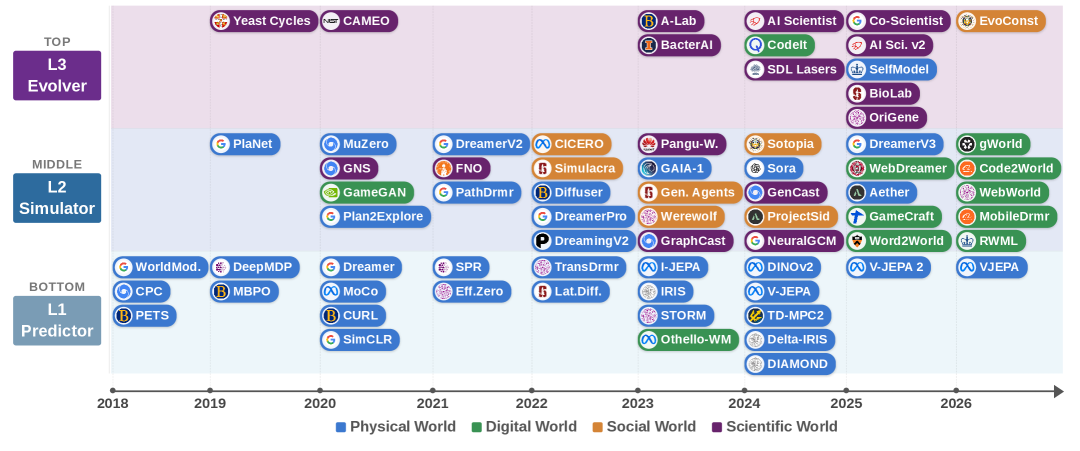
That angle clears up several things immediately.
First, many "world models" are in practice still L1 systems: strong at short-horizon prediction, but falling apart over rollouts. Second, L2 is not simply "generate for longer" but holding three properties at once: consistency, sensitivity to interventions, and constraint satisfaction. Third, L3 so far shows up rarely and in fragments: usually not as a full end-to-end system but as isolated self-checking or automated-experiment loops.
The authors also propose an important shift in how quality is judged: from prediction-oriented metrics to decision-oriented ones. That is, measuring not just visual similarity but whether a good world model actually changes an agent's real decisions for the better.
The main findings: where we actually stand
Compressed to a handful of theses, the paper's conclusions look like this.
First: the world-model field is fragmented. The RL community has long worked with dynamics models as a planning tool. The computer vision community usually discusses world models through video and 3D scene generation. LLM agents arrive at the same problems through browser use, tool use and social simulation. AI for science gets there through surrogates and autonomous labs. These branches have barely spoken to each other.
Second: most of the noise around world models comes from confusing plausibility with usefulness. A good video generator is not a good simulator. Handsome rollouts with no sensitivity to actions and no domain constraints amount to an animated hallucination.
Third: L3 is a separate qualitative step, not just "an even longer rollout." Once a system starts actively gathering data, hunting down the causes of its errors, adding new rules, tests or hypotheses, and validating the update, it belongs to a different class of capability. Scientific systems and some evolutionary loops stand out here.
Fourth: different worlds require different rollout validation. In physics you can check collisions and stability; in the digital world, executability and contracts; in the social world, consistency of norms and commitments; in science, the chain from hypothesis to experiment to measurement. A single universal benchmark is unlikely to be possible here.
Fifth: the paper builds, quietly but insistently, toward a deeper claim: genuine L3 may require not only latent representations but more explicit, partly symbolic structures. Neural networks absorb regularities superbly, yet they are poor at transparently revising "laws" as objects. This is especially visible in scientific problems, where human world models have historically taken symbolic form — equations, principles, invariants.
What this means for agentic AI right now
Set against the market and the research agenda, the paper lands right on the nerve of the moment. We are moving from the era of "the LLM as an interface" to the era of "the agent as the thing that gets tasks done." Which means the bottleneck shifts: speaking plausibly is no longer enough. You need a reliable answer to "what happens if I do X?"
For robots that means a world sitting between perception and control. For coding agents and web agents, a move from reactive chains to models of the environment in which actions can be safely replayed before execution. For multi-agent systems, the ability not just to generate dialogue but to hold on to the hidden state of social interaction. For scientific AI, closing the discovery loop instead of predicting from data that already exists.
The authors' point that a closed planning loop and L3 evolution are not the same thing is particularly useful. An agent can act in a closed loop without ever changing its world model. And in reverse, a system can have a mechanism for revising the model without being a full embodied agent. Pulling these two apart will make it easier to judge the many claims about "self-improving" systems soberly.
Takeaways
This survey is good not because it promises AGI soon but because it clears the romantic fog off the subject of world models. It offers a working frame in which you can ask honestly of any system: does it simply predict the next step, can it simulate alternative courses of action, or is it already able to rewrite itself after a collision with reality?
For a data and AI audience, the core point is this. The future of agentic systems most likely does not lie in endlessly scaling a universal predictor. It lies in combining three things: a dynamics model, respect for the laws of the specific world, and a mechanism for controlled revision of its own hypotheses. That junction is where the move toward "a system that can find its way in the world and improve its understanding of it" begins.
Perhaps the most valuable thing in the paper is that it turns the vague phrase world model into an engineering object with testable boundaries. That is already a rarity in this industry.
AI paper breakdowns
Every day we read the new AI papers and retell what matters in plain language — no hype, no filler. If you want to see where AI agents are heading before everyone else, subscribe.
New breakdowns every day
On Telegram